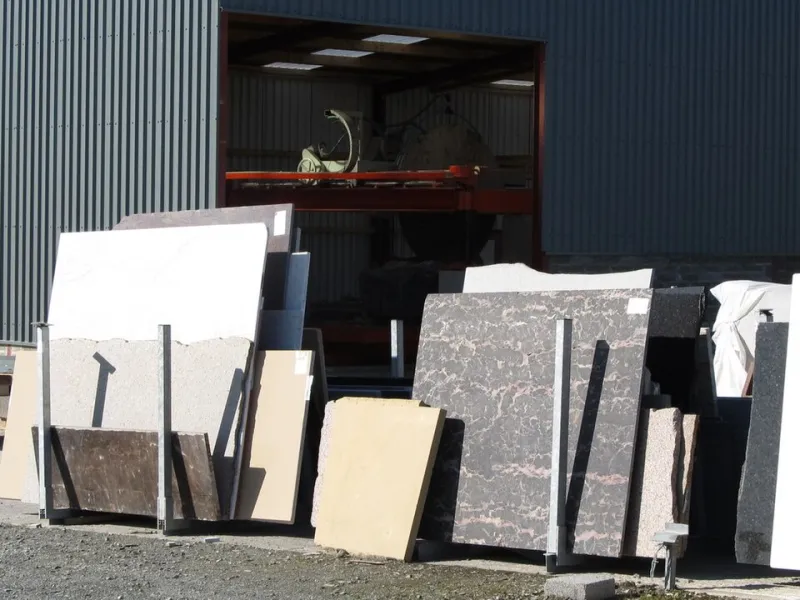
No Crane, No Drama: Shifting Slabs and Blocks Around a Small UK Workshop

Photo: moving stone slab pallet truck workshop masonry, via images-wixmp-ed30a86b8c4ca887773594c2.wixmp.com
Moving a slab around a builder's yard is a crane job. Moving it around your own shop is your job. Most small UK masonry workshops never see a hiab on the drive, and they do not need one. They need a few sensible bits of kit, a floor that behaves itself and a firm rule about where hands go.
Start with the weight, not the gadget
Stone is heavier than it looks, and granite is heavier than everything else. Use length x width x thickness in metres, multiplied by density.
- Sandstone: roughly 2,200 to 2,400 kg per cubic metre
- Limestone: roughly 2,300 to 2,550 kg per cubic metre
- Slate: roughly 2,700 to 2,800 kg per cubic metre
- Granite: roughly 2,700 to 2,900 kg per cubic metre
A 2.4m x 1.2m slab of 30mm granite works out at about 0.086 cubic metres, so around 240kg. That is not a two-man lift however brave your mate is. A 2.0m x 1.0m limestone hearth at 20mm is nearer 96kg - manageable for two people on a flat route, awkward on a step. The manual handling guidance is not a suggestion, and the further you hold a load from your body, the lower the safe weight goes.
Levers, toe jacks and rollers: the best value in the shop
A 1.5m pinch bar and a 5-tonne toe jack will move more stone than most people believe. The toe jack gets under a slab that is flat on the floor; the bar rolls and nudges it onto rollers. Three or four lengths of 20mm to 30mm steel pipe let you walk a slab across a flat floor with one hand and a strap.
Machine skates are the grown-up version - a set of four rated for 4 tonnes will carry a stillage or a pallet far more controllably than pipe on a rough floor. PTFE sheet is useful for lighter worktops and offcuts, but it does not like grit.
Rules that matter: flat concrete only, never gravel or a slope; chock the load before you reach for anything; keep hands out of pinch points; control the load with a strap, not your fingers.
Pallet trucks are useful, not magic
A 2.5-tonne manual pallet truck is the workhorse of a small stone shop. But a truck rated at 2.5 tonnes on a smooth warehouse floor is not a 2.5-tonne truck on cracked concrete with a 20mm lip at the door. Check the fork length - 1150mm is standard, 800mm is handy in tight shops - and check the pallet. A Euro pallet is 1200 x 800, so a 1.2m wide slab on one is an awkward, top-heavy load. Wide-fork trucks exist for exactly this reason.
Expansion joints, drains, ramps and wet patches are where loads tip. If the route crosses any of them, fix the route before you buy a bigger truck.
Gantries, jibs and the LOLER conversation
A portable gantry with a chain block is the closest thing to a crane you can keep indoors. A 1-tonne or 2-tonne gantry with a 3m beam will lift a slab off a rack and onto a bench without anyone's back being involved. It needs a level floor, a rated beam, rated slings and shackles, and a SWL plate you can actually read.
Under LOLER, lifting equipment needs thorough examination: six months for lifting accessories, twelve months for the gantry itself (and six months for anything rated to lift people). Do not cobble one together from scaffold tube and hope. For occasional jobs, hire a gantry for a week from a local lift supplier or a national hire chain rather than buying one that sits in the corner.
Vacuum lifters: brilliant on the right surface
Battery vacuum lifters are superb on polished or sawn, non-porous stone. They are less superb on porous sandstone, textured faces and dusty surfaces. Test the pad on an offcut before you trust it, always use the secondary safety strap, and keep the battery charged. Compressed-air venturi lifters need a decent compressor and dry air. Small units start around £1,200 to buy; hire one for a big installation week and save the capital.
Layout changes that beat any gadget
- Keep a clear 1.2m route from the door to the rack and the saw. Tape it on the floor so nobody parks a wheelbarrow in it.
- Get the rack within a couple of metres of the bench. Long carries are where backs go.
- Store heavy slabs at waist height, not on the floor and definitely not overhead.
- Flush thresholds or fit a small ramp. A 15mm lip stops a pallet truck dead.
- Use A-frame racks on rated castors, and lock the castors before loading.
- Keep a wheeled stillage for offcuts. It saves a hundred bends a week.
What to buy and what to hire
Buy: a pinch bar, a toe jack, four machine skates, a 2.5-tonne pallet truck if the floor is decent, rated slings and shackles, and a castor A-frame. Hire: a gantry for a week, a vacuum lifter for a big install, a telehandler for delivery day. Do not buy a forklift for occasional use - maintenance, insurance, training and floor space will eat the saving.
The bottom line
Two people, a toe jack and four skates will move most slabs in a small shop. The real risk is not the weight on its own; it is the weight plus a lip at the door, a slope, a wet patch or a rushed lift. Plan the route, do the maths and keep your hands out of the crush zone. No crane required.