Bench Space Isn’t Free: The Honest Maths Behind a Homemade Masonry Jig
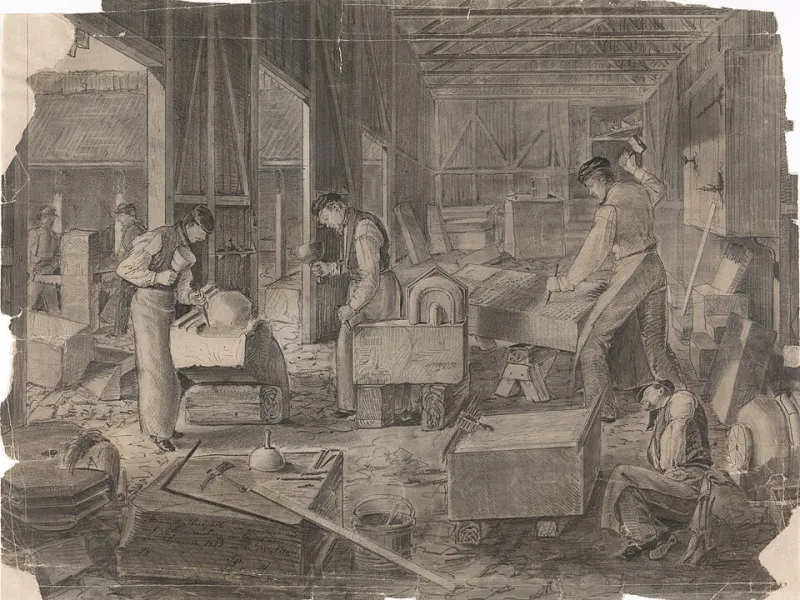
Photo: Wilhelm von Hanno, Public domain, via Wikimedia Commons
Every stone shop has a corner like this: a stack of plywood templates, a length of timber with a stop screwed to it, and a clamping frame that seemed like a brilliant idea on a wet Tuesday. Some of those jigs have paid for themselves ten times over. Others are just workshop archaeology.
The tricky bit is telling the difference before you spend another hour refining a fixture that only ever gets used on one job. A jig is not automatically clever because it is homemade. It is also not automatically a waste of time because it looks rough. The question is whether it earns its keep — and in a small UK stone shop, bench space is part of the cost.
A jig is a trade, not a trophy
A good jig buys you something specific: less setting out, fewer scrapped pieces, a safer cut, or a repeatable result when the customer wants six of the same thing. A bad jig buys you a false sense of precision and a longer list of things to trip over.
The useful distinction is between a jig that removes a decision and one that merely hides a badly set-up job. If your saw is out of square, a repeat stop will faithfully reproduce the error. If your bench is not flat, a clamping frame will hold the stone crooked with great consistency. Before you build anything, sort the machine and the bench. A jig should amplify a sound process, not paper over a sloppy one.
The four-part payback test
Forget the romantic idea that making a jig is always cheaper than buying one. Run the numbers on a scrap of paper. I use four measures.
1. Setup time saved
How long does the job take without the jig, including marking out, checking, repositioning and the odd curse? Then how long with it? Be honest about the first few uses, because a new jig always has a settling-in period. If it saves ten minutes per piece but takes two hours to build, it needs twelve pieces just to break even on labour.
2. Batch size
One-off arch? A template still makes sense if the geometry is awkward and the risk of a wrong cut is expensive. Ten coping stones? A sled or stop begins to look very sensible. The batch size is not just how many pieces you are doing today. It is how many you are likely to do over the next year. A repeat-cut stop for a common sill profile might earn its place even if this particular job only needs four.
3. Accuracy and risk
Some jigs are not really about speed. They are about not ruining a £300 slab of Portland stone at 4pm on a Friday. An arch template that keeps the voussoir angles consistent, or a clamping frame that holds a thin piece safely while you work it, can justify itself on one saved piece. Add in the safety angle and the maths often changes fast. A jig that keeps your hands away from a blade is not a luxury.
4. Storage and maintenance
This is where homemade kit quietly loses. A jig that lives on the bench, gets used weekly and needs no adjustment is a tool. A jig that lives under a bench, warps in the damp, and needs re-squaring every time you drag it out is a liability with a handle. Ask where it will live. If the answer is balanced on top of the compressor, it needs to be very good indeed.
Everyday examples
An arch template is the classic case. It might only be used twice a year, but when it is used it saves a day of setting out and a lot of nerve. That can pay back immediately. A coping sled for a repeated profile is the opposite: cheap to make, used often, and easy to store upright against a wall. A simple repeat-cut stop on a saw is nearly always worth having, provided the saw itself is set up properly. A clamping frame is the one people underestimate. It may not speed up the actual cutting, but it makes awkward pieces safer and more accurate. That counts.
The jigs that tend to fail are the over-engineered ones. The template with eight adjustable bolts. The sled with a fence that needs recalibrating every time it is moved. The frame that only fits one size of stone and now lives behind the door. Complexity is the enemy of repeatability in a small shop.
The hidden cost: false confidence
A jig can make a bad job look repeatable. If the first piece comes off the jig slightly off, every piece after it will be slightly off too. That is why the first article off any new jig should be checked against the actual job, not just against the jig. Check square, check the profile, check the fit. Then make the second one and check it again. If the jig is not giving you consistency, it is just giving you speed in the wrong direction.
When to build, buy or bin
Build when the job is repeatable, the risk of error is high, or the jig solves a safety problem. Buy when someone else has already solved the geometry and the price is less than your build time. Bin when the jig has not been used since the last time you moved it, or when it needs more maintenance than the job it supports.
A simple rule for 2026: if a jig does not save at least half an hour across a typical month, it needs to be either very small or very useful. If it saves an hour a month, it has earned its bench space. If it saves nothing but makes you feel like a proper craftsman, take a photo of it and put it in the skip.
The one-page decision
Write down the job, the number of pieces, the time saved per piece, the build time, and where the jig will live. If the time saved is greater than the build time plus the fiddle factor, build it. If the accuracy gain protects expensive stone or your fingers, build it. If it is a one-off that will never be used again, make a disposable template and move on.
Homemade jigs are part of the texture of a working stone shop. They are not a moral virtue. They are a trade: bench space, build time and faff in exchange for speed, accuracy and safety. Get that trade right and the jig pays for itself. Get it wrong and you have just built another thing to move when you need the bench.