Your Waste Skip Has a Daily Rate — Start Charging It to the Job
The skip looks like the cheapest thing in the yard. It arrives empty, you fill it with offcuts, broken slips and the bits of stone that never quite made it onto a job, and then it disappears. The problem is that it comes back. Month after month, the same cycle: hire, delivery, collection, possibly a council permit if it is sitting on the road, and a bill that never seems to match how full the thing looked.
For a small UK stone shop, waste is rarely one big cost. It is a dozen small ones stacked on top of each other. There is the skip itself, the labour spent carrying and sorting stone, the floor space given over to piles that nobody wants to touch, and the saleable material that gets buried because it was never recorded properly. None of that is free. It just does not arrive as a single invoice.
The skip is the visible bill
Start with what you can actually see. A build-up skip is not just the hire charge. You may be paying for delivery and collection, a permit if it is on the highway, and an exchange when it is full. Weight limits matter too. Stone is heavy, and a skip can hit its limit long before it looks full, especially if mortar, packaging and broken slabs are mixed in with clean offcuts.
That matters because mixed waste is usually the most expensive waste. Clean stone offcuts might be reclaimable, saleable or usable as fill on another job. Stone mixed with plastic wrapping, discarded blades, empty silicone tubes and general rubbish is a disposal problem. The skip company does not sort it for you, and nobody pays you for the good pieces hiding underneath.
What the pile is actually costing
A useful way to think about it is cost per fill, not cost per skip. If a skip costs you a few hundred pounds all in, and you fill it every three weeks, that is a monthly waste bill whether you write it down or not. Add the labour: two people spending twenty minutes here and there moving offcuts out of the way, loading the skip, and looking for a piece that was thrown out last week. Add the floor space. In a small workshop, a square metre of dead stone pile is a square metre that cannot hold a bench, a drying rack or a job in progress.
Then add the missed reclaim. That is the quiet one. You cut a windowsill from a larger slab, bin the remainder, and three weeks later buy a similar piece for a repair job. It happens in every stone shop. The offcut was not waste; it was stock without a label.
A five-minute waste-pricing routine
You do not need a spreadsheet with forty tabs. You need one month of honest tracking.
- Record every skip exchange. Date, size, cost, permit or delivery charge, and who filled it. Keep it on a clipboard by the door or a note on your phone.
- Give waste a job number. If a job generates a significant amount of offcuts, broken pieces or packaging, note it. After a month you will see which jobs are producing the most waste and whether your quotes are covering it.
- Put a labour rate on handling. A simple estimate is fine. If waste handling takes an hour a week at your normal charge-out rate, that is a real cost, not a rounding error.
- Separate the clean from the mixed. Keep a clearly marked offcuts area for stone that is genuinely reusable. Everything else goes in the skip. This one habit makes the next step possible.
- Price it into the quote. You do not need a line item called waste on every estimate. But your rates should assume a sensible amount of offcut handling and disposal. If a job is all small slips and fiddly cuts, it will produce more waste than a straightforward slab job.
Cut plans that shrink the pile
Most waste is decided before the saw starts. A cut plan does not have to be fancy. It can be a pencil sketch on the back of a delivery note, as long as it accounts for the whole slab rather than just the first piece you need.
Group cuts by job and by stone type. Cut the largest pieces first, then use the offcuts for smaller sections. Check the rack before you cut a new piece. That sounds obvious, but in a busy shop the rack becomes invisible after a while. Label remnants with the stone name, thickness and approximate size. A piece without a label is a piece that gets skipped.
Keep standard sizes where you can. If you regularly make 100mm slips, 150mm slips and 300mm sill sections, cut leftovers into those useful sizes rather than random lengths. Random offcuts feel like stock but behave like waste. Standardised offcuts get used.
Also be honest about what is worth keeping. Small, thin, awkward pieces with no obvious future are not stock. They are clutter. Keeping everything is not recycling; it is just delaying the skip.
The offcuts rack test
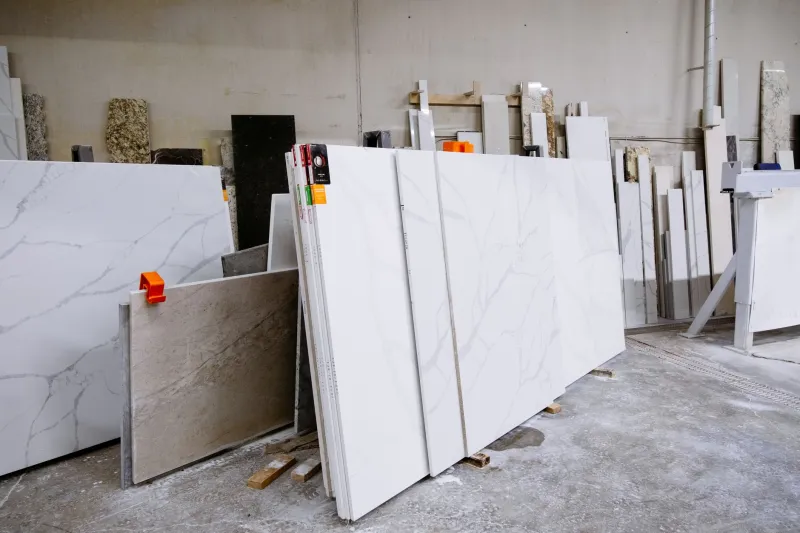
A dedicated offcuts rack pays for itself when it turns stone you would have binned into stone you actually use. That requires three things: a sensible location, clear labelling and a rule that the rack gets checked before new stone is cut.
Do the maths simply. If a rack costs £600 and it helps you reclaim £150 of saleable stone a month, it has paid for itself in four months. If it just becomes another place to pile unlabelled rubbish, it has cost you £600 and some floor space. The difference is not the rack. It is the routine around it.
A rack works best when it is near the saw, not tucked in a corner behind the compressor. It should be easy to slide a piece in and easy to see what is there. Vertical storage suits many offcuts, but heavy pieces need proper support and a safe way to move them. Do not create a leaning tower of stone just to feel organised.
What to do this week
Pick one job and one skip. Write down what the skip cost, how long it took to fill, and roughly how much of the contents could have been reused. Then look at your next cut plan and see if two or three pieces could be nested better. That is the whole exercise. You are not trying to eliminate waste; you are trying to stop paying for it twice.
The skip is not free. It never was. Once you start charging it to the job, even in a rough and ready way, you begin to see which habits are costing you money and which ones are just part of the trade. The goal is not a perfect workshop. It is a workshop where the stone you buy ends up on a wall, a floor or a client's property, rather than in a skip outside.